
Improving the lives of our clients for over 30 years.
Book NowThe clinical practice of Nicholas Barbousas
Understand the pattern. Work with
the whole.
Individual clinical sessions for people experiencing persistent patterns of tension, restriction, discomfort or movement difficulty.
Clifton Hill, Melbourne
Mondays, Tuesdays and Fridays
RElationships, not parts
Look beyond the area
that hurts
Where you feel discomfort matters. It does not always tell the whole story.The way we stand, move and load the body emerges from relationships between many regions rather than from individual muscles or joints acting in isolation.
Interconnective Drivers.
The relationships that carry load between regions, and the reason a session often works somewhere other than where you feel it.
Observation is used to develop possibilities,
not conclusions.
Those possibilities can then be explored through movement, touch, testing and the way your body responds.
the clinical process
A process built
around you.
Every session follows the same reasoning, whatever the presentation. It is a loop rather than a line, so what happens next is decided by what the last step actually showed.
01
Understand
We begin with the reason you have come in.
Your history, current symptoms, activities, previous injuries and what you would like to be able to do all help establish the context for the session.
02
Observe
Standing and movement may be used to look at relationships across the body.
The goal is not to label your posture as good or bad. It is to identify patterns that may be worth investigating further.
03
Test
Movement, palpation and simple positional or functional tests can help explore whether an observed relationship appears relevant.
04
Work
Treatment may combine hands-on structural and myofascial work with movement, positioning and body awareness.
What is used depends on what is found.
05
Re-check
We return to the things examined earlier.
Did movement change? Did the area feel different? Did the relationship we were investigating appear meaningful?
The response helps inform what happens next.
No menu to choose from
One session.
More than
one technique.
OLOS is not built around choosing the right treatment from a menu. You do not need to decide whether you require Rolfing, myofascial release, soft tissue work or movement therapy before you arrive.
Nicholas draws on different parts of his clinical background according to the person in front of him.
The technique serves the clinical process, not the other way around.
Before you book
Your first
session.
Your first appointment is both a treatment session and an opportunity to understand what may be happening. There is no automatic treatment program and no requirement to commit to a predetermined number of sessions.
The first visit page covers what to wear, what happens in the hour, whether this approach may suit what you are dealing with, and how to find the room.
$
160
Per session
60
min
Appointment length
3
days
Monday, Tuesday, friday
By appointment only
More than 30 years of clinical experience
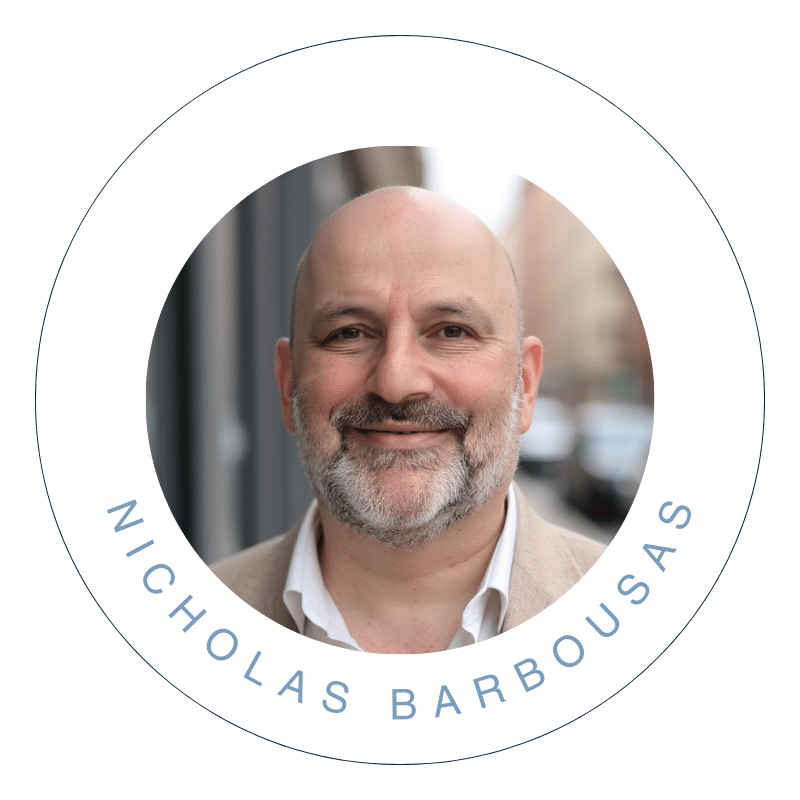
Nicholas Barbousas
Nicholas qualified as a Rolfing® Structural Integration practitioner in 1996 and has spent much of his career working at the intersection of hands-on therapy, movement, posture and practitioner education.
Alongside clinical practice, he has taught manual and movement practitioners for twenty-seven years, including university level teaching and professional education in myofascial and structural approaches.
That long clinical and teaching background has increasingly shaped one central question.
How do we move from noticing what is happening in the body to understanding which relationships may actually matter?
The answer became a body of work. Structural Pattern Recognition, the method of reading how a body has organised itself before deciding what to do about it, is now taught to practitioners and used in every session here.
ὅλος
OLOS · the whole
The name OLOS comes from the idea of the whole. Not because every problem has a single whole body explanation, and not because every part of the body needs treatment.
It reflects a simpler principle.
A part of the body is often easier to understand when we consider the relationships around it.
That principle has been at the centre of Nicholas's work for more than three decades.
The clinic
OLOS Health, Clifton Hill
Nicholas practises from CLIFTON HILL CHIROPRACTIC at:
167 Queens Parade
Clifton Hill VIC 3068
Appointments are available Monday, Tuesday and Friday.
Getting here
The clinic is on Queens Parade in Melbourne's inner north, with tram, train and street parking options nearby.
access
Access to the treatment rooms involves stairs. If stairs are difficult for you, call before booking.
If you are a practitioner
The frameworks used here are taught two ways. One to one mentoring on your own caseload, or structured courses including the Case Review Clinic.